Physical Address
Market Street , Kamokya KAMPALA
Physical Address
Market Street , Kamokya KAMPALA
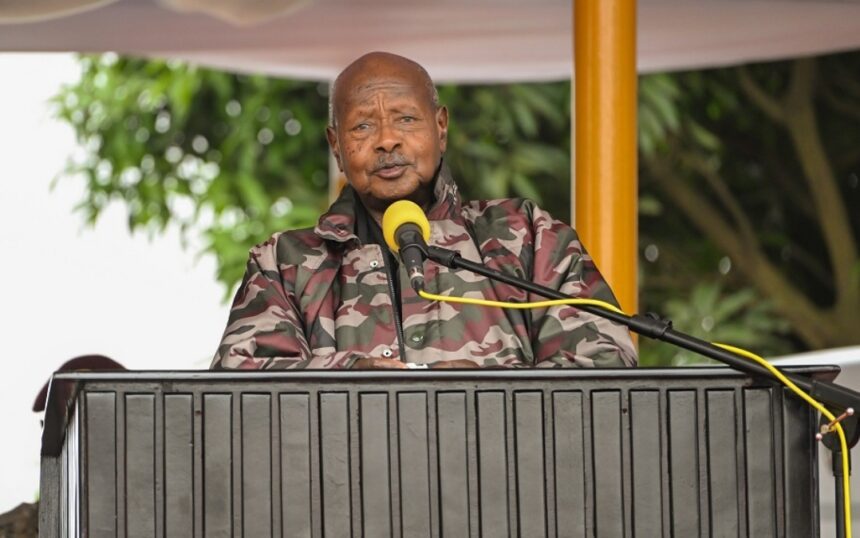
President Yoweri Kaguta Museveni, Uganda’s Head of State and Commander-in-Chief of the Uganda People’s Defence Forces (UPDF), has urged leaders to anchor governance in solving citizens’ day-to-day challenges, describing this approach as the ideological backbone of the National Resistance Movement (NRM) since its formative struggles of the 1960s. The President made the call while officiating at the election of UPDF representatives to Parliament, held at the Land Forces Headquarters in Bombo.
Addressing delegates at the Defence Council Delegates Conference, President Museveni emphasized that effective leadership must begin with understanding problems that can be practically resolved and taking deliberate action to address them. He noted that this philosophy has guided the NRM throughout its political journey.
During the conference, UPDF officers elected ten representatives—seven men and three women—to represent the force in Uganda’s 12th Parliament.
Those elected on the male category include Lt. Gen. Sam Okiding, who emerged with 340 votes, followed by Lt. Gen. James Mugira with 303 votes and Lt. Gen. Sam Kavuma who secured 282 votes. Brig. Gen. Gonyi David obtained 266 votes, Maj. Gen. Henry Masiko received 251 votes, Maj. Gen. James Kinalwa garnered 241 votes, while Brig. Gen. Joseph Ssemwanga polled 198 votes.
The female representatives elected are Col. Meeme Sylvia with 314 votes, Col. Ikiriza Knight who obtained 307 votes, and Col. Nekesa Christine Situma who secured 261 votes.
In his remarks, President Museveni expressed appreciation to the UPDF High Command for their role in nominating the officers and reiterated the need for leaders who can clearly identify and act on citizens’ attainable needs. He drew reference to the Runyankore principle of “okukyenura,” which he explained as the intentional process of diagnosing and resolving practical societal problems.
Reflecting on the NRM’s early years in government, the President recalled that by 1996 the Movement had restored discipline within the armed forces, rejected divisive sectarian politics, addressed shortages of essential goods, rehabilitated infrastructure, and introduced immunisation programs against six major childhood diseases—achievements he said earned widespread public trust.
He further outlined government interventions aimed at improving livelihoods, including Entandikwa, Universal Primary Education, army-supported schools, NAADS, Operation Wealth Creation, and the Parish Development Model, which he noted is currently yielding visible benefits at the community level.
According to the President, the renewed public enthusiasm observed in recent elections reflects both these socioeconomic efforts and the sustained peace under the NRM. He explained that UPDF representatives in Parliament serve as strategic observation points, enabling early detection of national concerns and timely reporting to military leadership to avert policy missteps.
As an illustration, he cited the controversial decision by Members of Parliament to raise their salaries, arguing that such issues could be addressed early if effective oversight mechanisms were fully utilized.President Museveni also tasked the newly elected UPDF legislators to closely track key government programs, including the Parish Development Model, free education, road infrastructure development, and immunisation. While acknowledging progress in preventive healthcare, he noted persistent gaps in curative health services.
On matters of electoral governance, the President reaffirmed the NRM’s long-standing objective of empowering Ugandans to choose their leaders through universal suffrage and secret ballots. He revealed that anomalies detected during the 2021 general elections—including an estimated 2.7 million irregular votes—prompted his push for biometric voter verification systems, though he observed these were not fully implemented.
He stressed that national stability depends on allowing citizens the freedom to elect leaders of their choice and commended the UPDF and other security agencies for maintaining peace during the recently concluded elections.
Meanwhile, the Chairperson of the Independent Electoral Commission, Justice Simon Byabakama, applauded UPDF officers for demonstrating discipline throughout the electoral process and expressed optimism that similar conduct would characterize other national elections. He urged all stakeholders to embrace unity as the country transitions from the election period.
During the same event, President Museveni commissioned three officer cadets presented by Maj. Gen. James Kinalwa, Joint Staff for Human Resource Management. The newly commissioned officers are Bazalaki Timothy, who trained at the General Sir John Kotelawala Defence University in Sri Lanka, alongside Akoi Moses and Piloya Vivian, both of whom completed their military training in Tanzania.